Was Shri Guru Nanak Dev Ji a muslim Part 1 of 4 (Basics of Sikhi)(Bhai Jugraj singh)
Defining Islam and Contrasting Sikh Beliefs
(00:33) The video begins by directly stating that Guru Nanak Dev Ji was not a Muslim and establishes the criteria for being considered a Muslim: belief in one God (Allah), acceptance of Prophet Mohammed as the final messenger, and adherence to Islamic teachings.
(01:07) While Sikhism also believes in one Creator, called Vaheguru, the Sikh concept differs from the Islamic one. Vaheguru is seen as immanent, residing within all individuals, and accessible through inner spiritual connection and purification.
(01:18)Sikhi emphasizes the concept of the Guru as the perfect reflection of Vaheguru’s light. Devotees can bow to, praise, serve, and accept the Guru’s Hukam (divine order) as the will of Waheguru. This differs from the Islamic view of prophets, who are messengers but not divine manifestations.
(02:11)The video quotes Guru Arjan Dev Ji, stating “Gur Parmesar Eko Jaan,” meaning the Guru and Vaheguru are one, and whatever the Guru does is accepted in the court of Vaheguru, solidifying the divine status of the Guru in Sikhi.
(02:19)Guru Nanak Dev Ji presented himself as a messenger of Vaheguru with unique teachings. The Sikh concept of Guru goes beyond the role of a messenger, creating a substantial difference from Islam.
Examining Guru Nanak Dev Ji’s Life and Background
(02:39)The video introduces its argument that Guru Nanak Dev Ji did not live as a Muslim and promises to explore his life, actions, teachings (theology of Sikhi), and the passing on of Guruship to support this claim.
(03:05)Guru Nanak Dev Ji was born into a Hindu family and initially studied under Hindu scholars, absorbing Hindu scriptures and traditions. This upbringing contrasts with being raised in a Muslim household.
(03:24) Despite later studying with a Muslim scholar and being knowledgeable about Islam (demonstrated by his fluency in Persian), Guru Nanak Dev Ji never recited the Shahadat (declaration of faith), indicating that he never formally converted to Islam.
(03:45) The video refutes claims that Guru Nanak Dev Ji’s early emphasis on the Oneness of God indicates Muslim identity, explaining that the concept of the Oneness of Vaheguru was present only in Sikhi. Connecting the sangat to Waheguru through the Gurshabad is only found in Sikhi.
Analyzing Marriage and Family Life
(04:01)Guru Nanak Dev Ji did not get married according to Hindu or Muslim rites. Instead, he initiated a new ceremony centered around the symbol “Ik Oang Kaar,” which is unique to Sikhism. Guru Nanak Dev Ji married Mata Sulakhni at Gurudwara Kandh Sahib in Batala, Punjab, India. This Gurudwara is a revered site where Guru Nanak’s marriage ceremony took place in 1487.
(04:30)The fact that Guru Nanak Dev Ji created a marriage ritual using ‘Ik Oang Kaar’ proves that at the point of his marriage, he had already established his own identity different from Hinduism and Islam.
(04:38)His marriage rituals angered Hindus, who even tried to harm him, showing that he was going against the customs of Hinduism.
(04:55)The video highlights that Guru Nanak Dev Ji’s sons, Siri Chand and Lakshmi Chand, had Hindu names, further suggesting a disconnect from Islamic identity and practices.
(05:11)Guru Nanak Dev Ji rejected Hinduism(At the time, this was in 6 schools of thinking), and he did not become a Muslim.
Spiritual Awakening and Distinct Teachings
(05:21)His emergence from the river, Guru Nanak Dev Ji proclaimed, “Na Koi Hindu, Na Musalmaan” (there is no Hindu, no Muslim). This declaration signifies his rejection of existing religious labels and the establishment of a new, universal path.
(05:43)Guru Nanak Dev Ji’s denial of the existence of Islam is a very un-Islamic thing to do.
(05:51)He described his mission as being a ‘dhadi’ (bard), singing the praises of Vaheguru, not spreading Islam. This reinforces the distinct nature of his spiritual purpose.
(06:08)The emphasis on spreading ‘Naam’ (remembrance of God) rather than Islam further highlights the independent nature of his mission.
(06:35)Guru Nanak Dev Ji did not join Muslim prayers in a mosque, and when questioned, criticized the lack of sincerity in the worshippers’ hearts. This demonstrates his divergence from Islamic ritual practices and his emphasis on genuine spiritual connection.
(07:04)The video underlines that if Guru Nanak Dev Ji were a Muslim, he should have joined in the prayer rather than assuming to know what is in other people’s hearts.
Role of Companions and Message of Inclusion
(07:29)While Bhai Mardana, Guru Nanak Dev Ji’s companion, was a practicing Sikh, the video questions whether his actions (playing music for Guru Nanak Dev Ji’s hymns) would be accepted by all Muslims.
(07:40)Bhai Mardana was playing the rabab so that Guru Nanak Dev ji could sing to it, so he was helping Guru Nanak Dev ji to preach his message.
(07:49)Guru Nanak Dev Ji was singing what he says is the revelation from Vaheguru directly, not from Allah, and Bhai Mardana accepted that.
Conclusion
The video uses historical, theological, and practical evidence to support its claim that Guru Nanak Dev Ji was not a Muslim, emphasizing the distinct nature of Sikhism as a unique spiritual tradition.
Was Shri Guru Nanak Dev Ji a muslim Part 2 of 4 (Basics of Sikhi)(Bhai Jugraj singh)
Guru Nanak Dev Ji’s Visit to Mecca
Historical Source: The account is based on Bhai Gurdaas Ji’s writings, a close disciple and the nephew of the third Guru, who lived through multiple Gurus and knew Sikh history intimately.
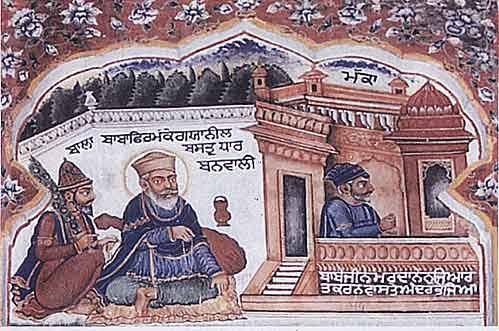
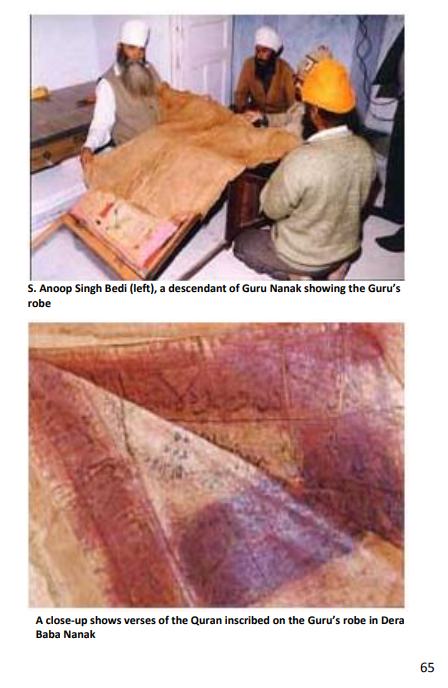
Travel Details: Guru Nanak Dev Ji went to Mecca, wearing a blue robe carrying a book with pauris of Jap Ji Sahib and other different bania, intentionally dressed differently to provoke debate and not to appear Hindu or Muslim.
Appearance and Attire: He wore a ‘silli toppee,’ a traveling garment, not an Islamic turban, aiming to avoid blending in. His appearance was deliberately non-conformist.
Entry into Mecca: Unlike Muslim pilgrims, he did not perform the Hajj or visit Mina, indicating that visiting Mecca alone was not a sign of being Muslim.
Hajj Significance: Hajj is crucial for Muslims, but Guru Nanak did not complete this ritual, and subsequent Gurus did not visit Mecca, implying that such a pilgrimage was not essential to his spiritual path.
Challenges to Islamic Practices and Beliefs
Questioning the Hajj: Guru Nanak demonstrated that merely performing Islamic rituals does not determine spiritual truth.
Interaction with Muslim Scholars: He debated with religious scholars, challenging their doctrines such as the significance of the Kaaba and the quran, the concept of seven heavens and hells, and the superiority of Islam.
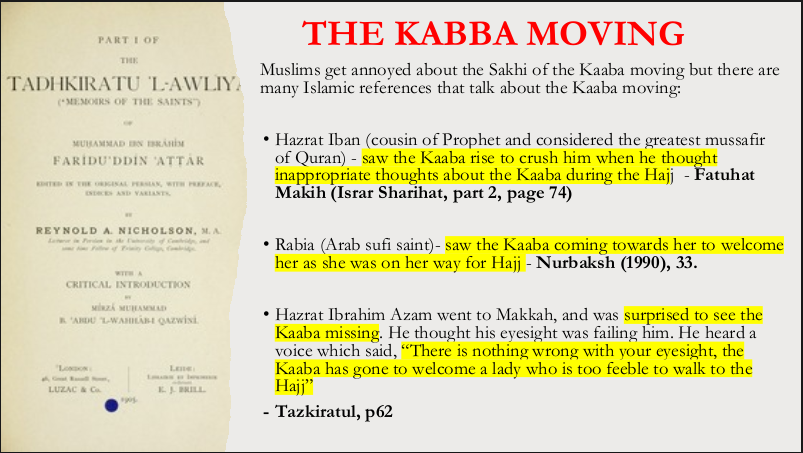
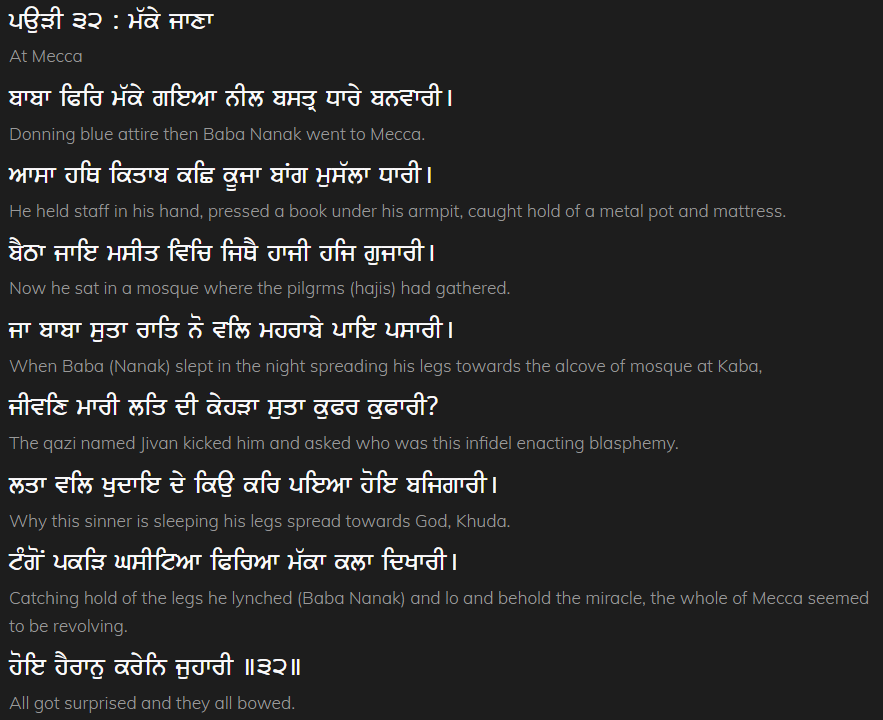
Sleeping Towards the Kaaba: Guru Nanak sleeping with his feet directed towards the Kaaba was sacrilegious from a Muslim perspective. His prayer implied a rejection of idolization and ritualistic worship.
Miraculous Demonstrations: Guru Nanak created a spectacle where he moved the entire city of Mecca by spinning the Kaaba, contradicting Islamic claims of the Koran’s divine miracle.
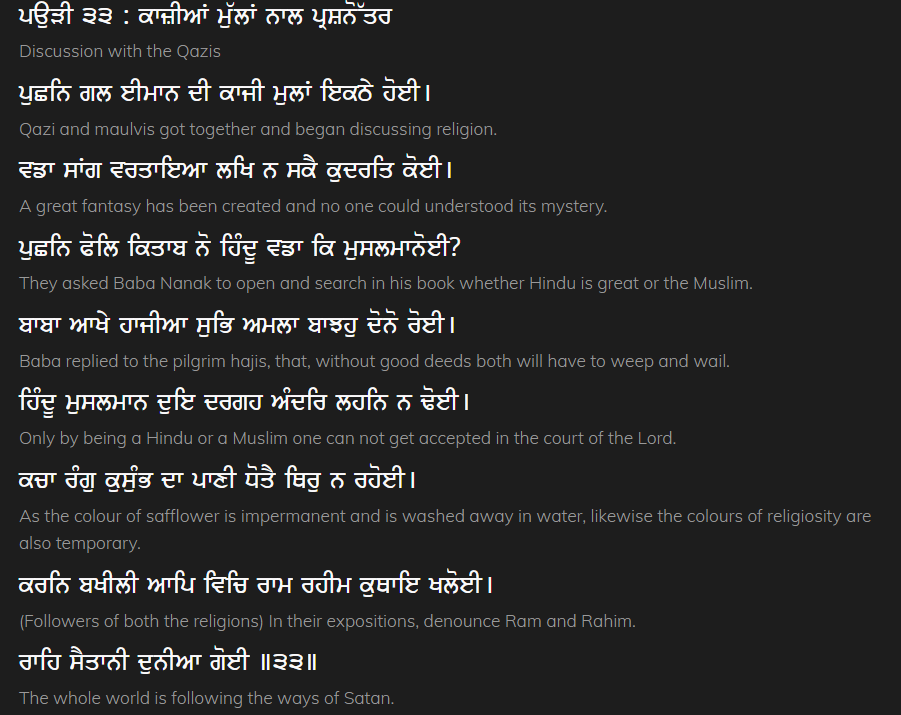
Questioning Religious Superiority: When asked which religion is better, he emphasized actions and deeds over labels, stating that religion is superficial and that character and conduct are what matter ultimately.
Travels and Dialogues in Other Religious Places
Visit to Buddhist and Hindu Sites: Guru Nanak also traveled to Sri Lanka, Tibet, and Varanasi, engaging in dialogues with scholars of Hinduism and Buddhism, further demonstrating his universal approach. You can read this in Siddh Ghosth and further in detail within Janamsakhis.
Rejection of Religious Labels: His visits and debates show that he did not see himself confined to any single religion but promoted understanding within the inner self and the truth.
Promotion of Inner Virtue: Guru Nanak emphasized that labels like Hindu or Muslim are superficial; what counts is living a life of virtue, kindness, and good actions.
Critique of Islamic Doctrines
Disputes in Baghdad: Guru Nanak challenged the Islamic concept of seven heavens and seven hells, claiming there are thousands, in a debate with a Muslim priest.
Miracles Against Islam: He demonstrated supernatural powers, such as traveling spirits and participating in miracles like traveling with the son of a Qazi and returning with holy offerings, which Islam considers divine-only abilities.
Accusations of Shirk: His actions, such as moving the Kaaba and performing miracles, are portrayed as acts of shirk (associating others with God) from an Islamic perspective.
Questioning Divine Authority: His behavior and questions effectively undermine Islam’s divine claims of the Quran and Prophet Muhammad’s miracles, promoting a spiritual perspective rooted in individual deeds over ritualistic faith.
You can view “Taajudin’s Diary Account of a Muslim author who accompanied Guru Nanak from Makkah to Baghdad” by Sant Syed Prithipal Singh ne’ Mushtaq Hussain Shah. This book is the history and witnesses to Shri Guru Nanak Dev Ji in Mecca.
Was Shri Guru Nanak Dev Ji a muslim Part 3 of 4 (Basics of Sikhi)(Bhai Jugraj singh)
Life and Establishment of Kartarpur
Guru Nanak Dev Ji returned to set up a town called Kartarpur and formed a community of Sikhs.
He lived there, spreading his spiritual message and teachings. Teaching including but not limited to not praying to idols, not praying at a certain direction, not practicing slavery, not practicing the varna system(Caste system), etc.
Theological Differences with Islam
Claiming Guru Nanak Dev Ji was a Muslim is incorrect; his teachings contradict core Islamic beliefs. Islam rejects reincarnation, which Sikhi advocates, with Guru Nanak discussing past and future lives. Guru Nanak claimed to be a Guru and spoke directly from Vaheguru, establishing his divine authority, contradicting Islam’s concept of prophethood. Guru Nanak’s practices, such as worshiping him and taking Amrit by washing his feet, suggest elevating himself to a divine partner, opposing Islamic monotheism.
Writings and Revelations
Guru Nanak wrote his own Gurbani, claiming it came from Vaheguru, which conflicts with Islam’s view of the Quran as the final revelation. He did not instruct Sikhs to honor the Quran or Islamic rituals, but rather focus on the Guru’s Bani. His prayers, like Jap Ji Sahib, Rehras Sahib, and Kirtan Sohila, are different from Islamic prayers, and he never used Islamic terms like “Bismillah.”
Music and Worship Practices
Guru Nanak composed Shabads in raag, emphasizing music as integral to worship. Sikh kirtan involves singing Gurbani with music, unlike Islamic recitations of the Quran. Musical traditions in Sikh worship are incompatible with Islamic practices. In Sikhi, the sikhs believe that the gurshabad brings you to Sachkhand instead of any other book or article of faith.
Historical and Social Actions
Guru Nanak faced imprisonment—an unlikely event if he was a Muslim aligned with Muslim authorities. He established Langar, offering free community meals, a practice not found in Islam, which emphasizes charity but not communal free food.
Concepts of Spirituality and Truth
Sikhi believes Vaheguru is everywhere, and truth exists universally. Guru Nanak Dev Ji is seen as the embodiment of complete truth from Vaheguru, unlike other religions, which contain parts of the truth. Sikhi rejects the exclusivity of religious truth and embraces similarities across religious traditions, including Christianity and Judaism.
Critique of Religious Labels and Claims
Sikhi advocates stepping onto Guru Nanak’s path rather than Islam; Sikhi is a distinct spiritual journey. Some compare Sikhi to Sufism but note major differences, such as Sufis’ deviations from Islamic orthodoxy through practices like qawwali. Guru Nanak did not follow Kabir Ji, though both criticized Islam; Guru Nanak was a Satguru with direct divine enlightenment. In fact, Bhagat Kabir ji followed Shri Guru Nanak Dev ji. In Bhagat Kabir Ji’s bani, we see that he references the importance of a satguru, that being Shri Guru Nanak Dev ji.
Conclusion
Sikhi is a separate faith based on direct divine revelation from Guru Nanak, rejecting the claims of Islam and other religions to exclusivity. The teachings and practices of Guru Nanak Dev Ji underscore a universal path rooted in spiritual truth, not confined to any one religion.
Was Shri Guru Nanak Dev Ji a muslim Part 4 of 4 (Basics of Sikhi)(Bhai Jugraj singh)
Definition of a Muslim
A Muslim believes in one Almighty God (Allah), accepts Prophet Mohammed as the last messenger, and lives according to Islam’s teachings. Guru Nanak Dev Ji did not accept these three core aspects of Islam. Also Shri Guru Nanak Dev ji critiqued the religion of Islam, you will find this practice with all the gurus.
Concept of Vaheguru and Divine Connection in Sikhi
Sikhi acknowledges one Creator, called Vaheguru, but with a different understanding. Vaheguru is inside humans; connecting to this divine light purifies the soul. Guru Nanak Dev Ji embodies this divine light and is seen as a reflection of it. The Guru and Vaheguru are one; following the Guru is equivalent to serving the divine.
Guru Nanak Dev Ji’s Self-Identification and Teachings
Guru Nanak Dev Ji describes himself as a messenger of Vaheguru but not a follower of Islam. He teaches a different way of life, focusing on connecting to the divine light within, not on Islamic practices. He explicitly states “Na Koi Hundu, Na Musalmaan” (No Hindu, No Muslim) upon awakening from his spiritual experience, rejecting religious labels.
Historical Life and Upbringing
Born into a Hindu family; his early education was in Hindu scriptures and later in Islamic knowledge. Despite learning about Islam, Guru Nanak Dev Ji did not adopt Islamic beliefs or practices. He never recited the Shahadat, indicating he was never a Muslim in faith.
Marriage and Family
Guru Nanak Dev Ji married according to his own spiritual principles, not Hindu or Muslim rites, symbolized by the ‘Ik Oang Kaar’. His wife was from a Hindu family, as indicated by the Hindu names of their children (Siri Chand and Lakshmi Chand). This cultural background shows he was not Muslim, and his rejection of Hindu customs highlights his spiritual independence.
Practices and Actions Reflecting His Spiritual Path
He went to sit in a river, received Guruship directly from Vaheguru, and began spreading the divine Name (Naam). His mission was to spread the divine naam, not Islam. He refused to join Islamic prayer (Namaz), citing the insincerity of the worshippers’ intentions. His language and actions, such as not participating in Islamic prayer and writing the ‘Ik Oang Kaar’, signify his departure from Islamic practices.
Interaction with Islamic Practices
During Islamic prayer, Guru Nanak Dev Ji chose not to join, emphasizing that people’s minds were not focused on prayer. His teachings focus on internal devotion rather than external rituals. The Muslim practice of ‘Ghayb’ (unknown) is contrasted with Sikhi, which emphasizes a personal internal connection with Vaheguru.
Bhai Mardana’s Role and Relationship
Bhai Mardana, a practicing Sikh, was Guru Nanak Dev Ji’s loyal companion. His role was to facilitate Guru Nanak’s divine singing and spreading of the divine message. Bhai Mardana Ji was a sikh; some scholars who say he’s a muslim are wrong. When someone who practices basic sikh rehat(code of conduct) that Guru sahib gave him and rejects muslim practices and does sikh practices is a sikh.
Overall Divergence from Islam
Throughout his life, Guru Nanak Dev Ji demonstrated his rejection of Islamic doctrines such as the Shahadat, Islamic prayers, and societal customs. His unique focus on internal divine realization and rejection of external religious labels makes Sikhi distinctly different from Islam.
The narrative highlights the importance of recognizing Guru Nanak Dev Ji’s teachings as a spiritual path rooted in divine connection, not as adherence to Islamic faith.
Shri Guru Nanak Dev Ji in Mecca
TCA RESPONSE

Ruling party fatwa in mecca of the rules of entering the area of kabba
They allowed non-Muslims who believed in one god to enter at this time. The rule is that no polytheist may enter the area of the Kaaba.
Bhai Gurdas Ji - Guru Sahib in Mecca
Bhai Gurdas Ji - Discussion Guru Sahib Had With the Qazis in Mecca

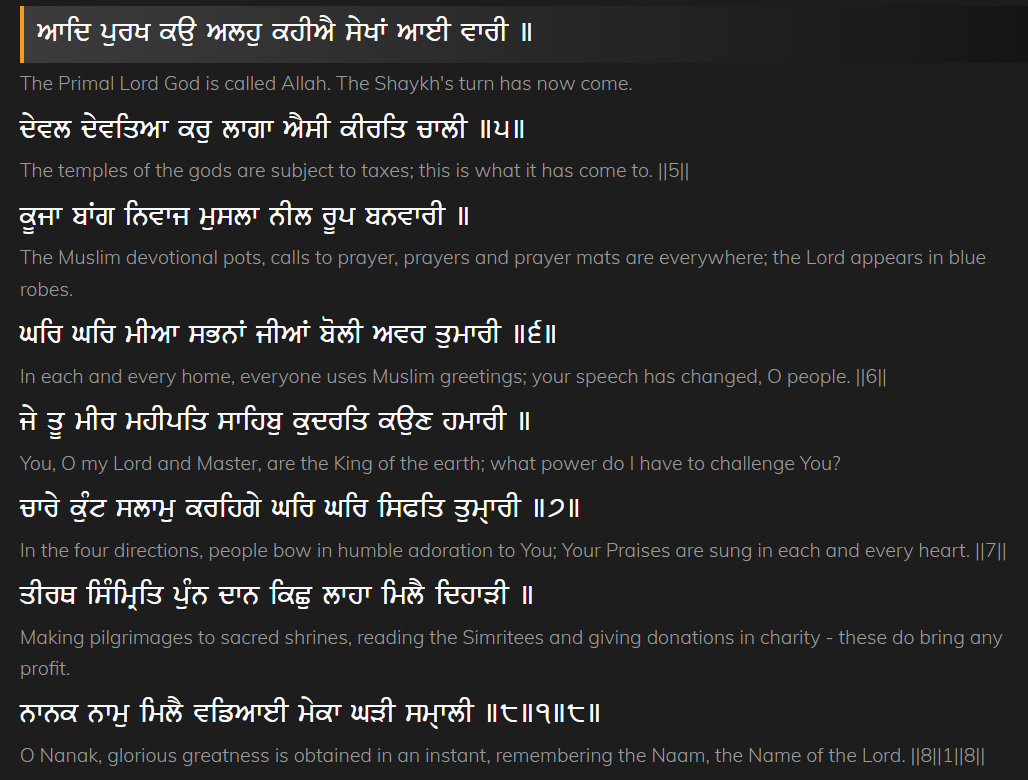
Shri Guru Nanak Dev Ji is not pleased with the spread of Islam. Islam made the muslims into kings(collection of jizya) (circumcision) (Singing the praise of Prophet Mohammed). Everywhere you go, you find this religion, Islam. As a consequence, all of their good deeds are erased. To earn good deeds and reverse these bad deeds, one must jap naam through the Guru.
This shabad is on Ang 1190
Tajudeen's Diary (English translation)
Pages From The Diary

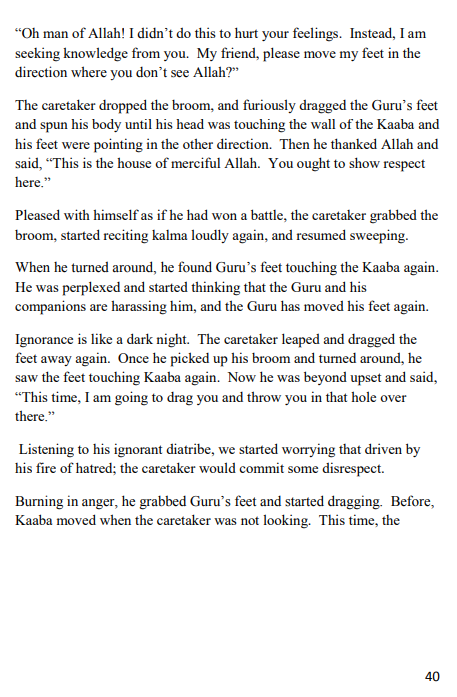
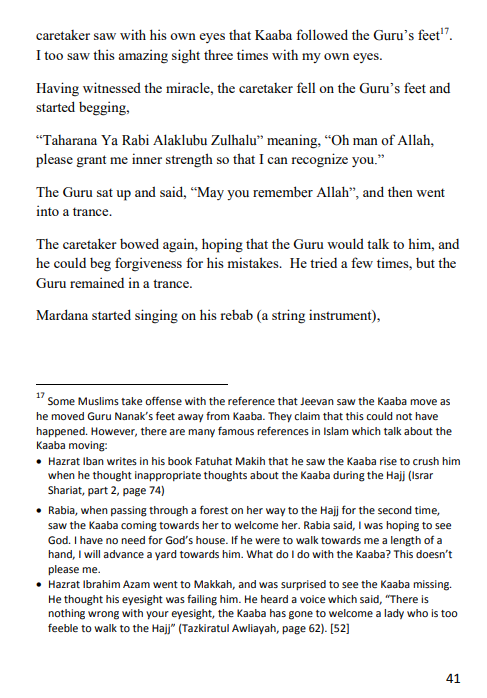
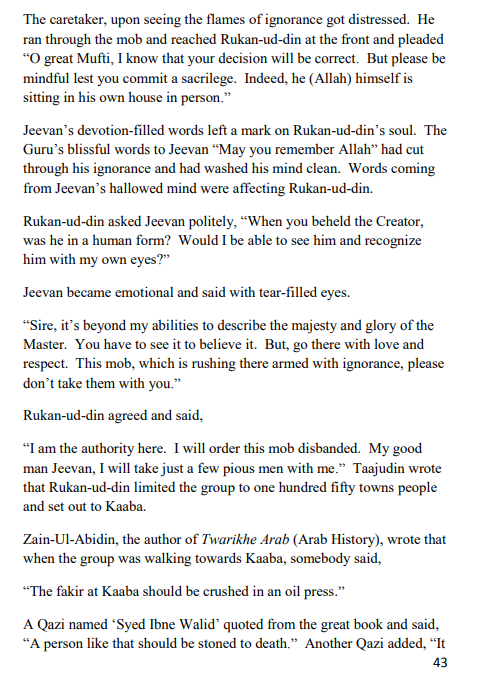
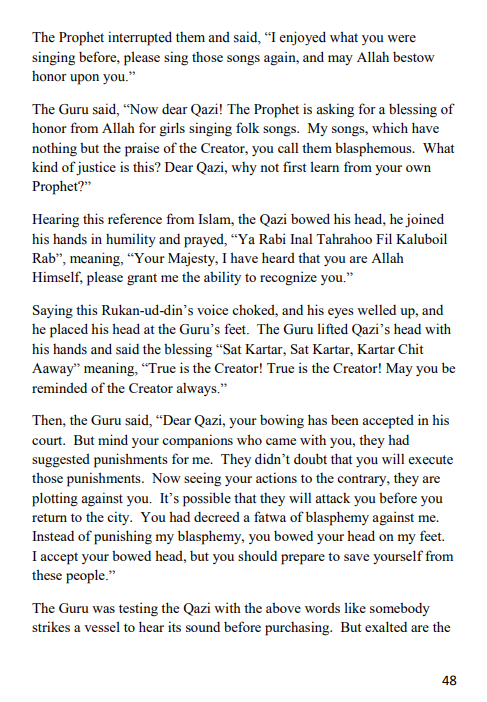
Where the Guru intentionally falls asleep with his feet resting against the Kaaba to awaken the locals from their superstitions. An angry caretaker, identified as Jeevan, discovers him and repeatedly tries to drag the Guru’s feet away to show respect to the house of Allah. In response, the Guru asks the caretaker to move his feet in a direction where Allah cannot be seen. As the caretaker drags him, the Kaaba miraculously shifts to follow the Guru’s feet. Witnessing this sight, Jeevan falls at the Guru’s feet and begs for the inner strength to recognize the Divine.
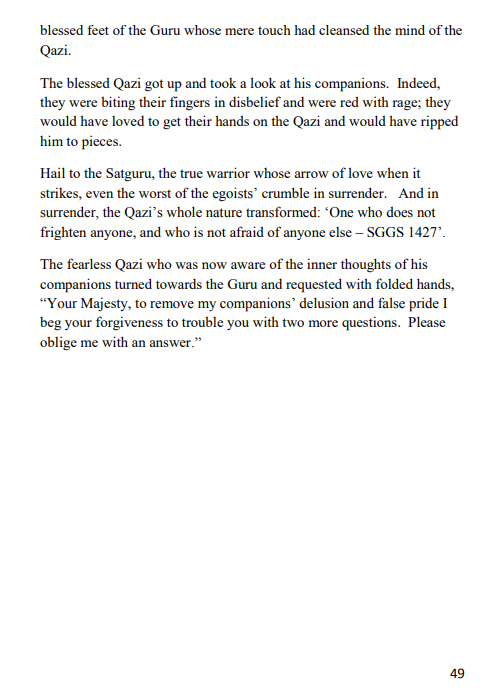
Moved by the Guru, Jeevan pleads with the Mufti, Rukan-ud-din, to disband an ignorant mob that wants to violently punish the Guru. Rukan-ud-din agrees to approach the Kaaba with only a small group of pious men. After the Guru challenges his understanding of justice, Rukan-ud-din is deeply humbled and bows his head at the Guru’s feet. The Guru blesses him but warns that his companions, who had earlier suggested the Guru be stoned to death or crushed in an oil press, are now enraged at the Qazi’s submission. Completely transformed and fearless, the Qazi asks the Guru for permission to pose two more questions to cure his companions of their delusions.
Shaheed Bhai Rukhudin

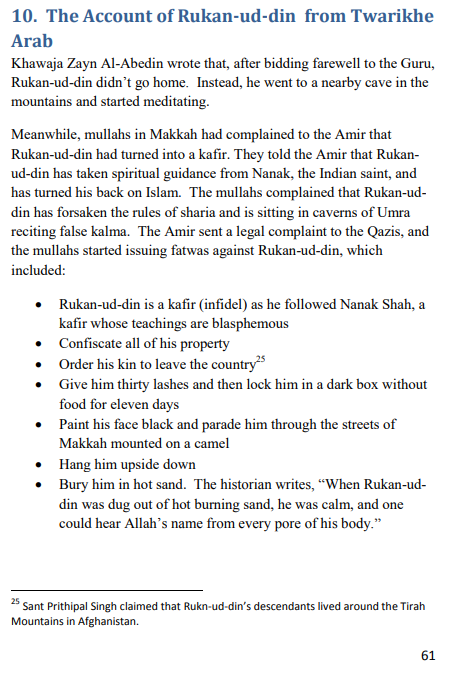
After experiencing a joyful night of kirtan with the Guru at the Kaaba, Bhai Rukan-ud-din chose not to return home. Instead, he bid farewell to the Guru and retreated to a nearby mountain cave to meditate.
His devotion to the Guru drew the ire of the mullahs in Makkah, who reported to the Amir that Rukan-ud-din had become an infidel by following an Indian saint, Nanak, and forsaking the rules of sharia. This led to a series of severe fatwas issued against him.
The decreed punishments were extreme and included:
Declaring him a kafir (infidel) whose teachings were considered blasphemous.
Confiscating his property and banishing his family from the country.
Administering thirty lashes and locking him in a dark box without food for eleven days.
Painting his face black and parading him through the streets on a camel.
Hanging him upside down and burying him in hot sand.
Despite enduring the torture of being buried in burning sand, Rukan-ud-din remained entirely calm, with historians noting that the name of Allah could be heard radiating from his body.
Accounts Where Kaaba Moved On Separate Occasions